
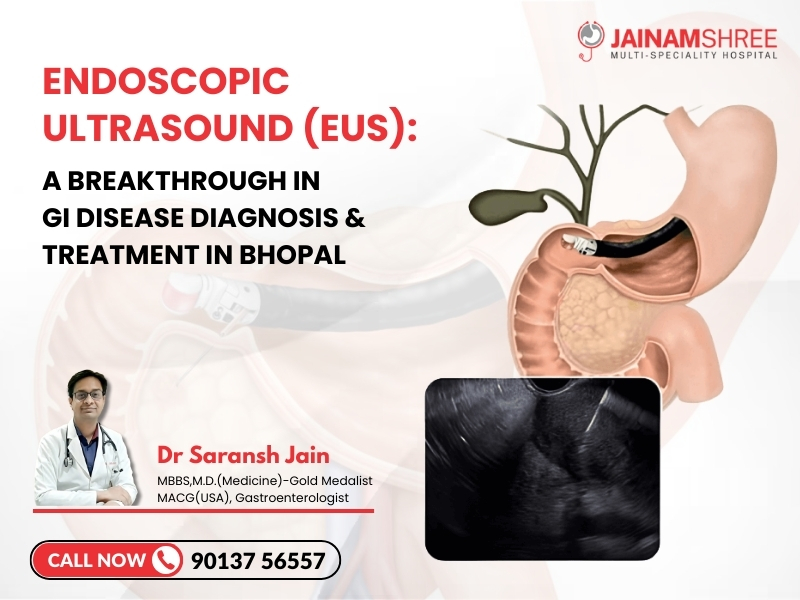
Digestive disorders involving the liver, pancreas, gallbladder, and bile ducts often progress silently. In many patients, symptoms appear only when the disease has already advanced, making treatment more complex. Early and accurate diagnosis is therefore critical for better outcomes and long-term health. One of the most reliable tools for early detection today is Endoscopic Ultrasound in Bhopal. This advanced, minimally invasive procedure allows doctors to closely examine the digestive tract and surrounding organs with exceptional clarity. In many cases, diagnosis and treatment can be performed in the same session. Skilled Gastroenterologists in Bhopal, such as Dr. Saransh Jain, use Endoscopic Ultrasound to deliver precise, personalized care for complex gastrointestinal and hepatobiliary conditions.
What Is Endoscopic Ultrasound in Bhopal and How Does It Work?
Endoscopic Ultrasound in Bhopal (EUS) combines two powerful medical technologies to provide detailed internal imaging:
1. Endoscopy
A thin, flexible tube with a high-resolution camera is passed gently through the digestive tract. This allows direct visualization of the esophagus, stomach, and intestines in real time, helping identify surface abnormalities clearly.
2. Ultrasound
High-frequency sound waves generate detailed images of internal organs. Unlike external ultrasound, Endoscopic Ultrasound in Bhopal places the probe inside the digestive tract, very close to organs such as the pancreas, liver, gallbladder, bile ducts, and lymph nodes.
Because the ultrasound probe is attached to the endoscope, doctors can assess:
- Inner lining of the stomach and intestines
- Deeper layers of the GI wall
- Nearby organs and lymph nodes
This close proximity allows Endoscopic Ultrasound in Arera Colony Bhopal to detect small tumors, cysts, stones, and early disease with far greater accuracy than conventional imaging.
Endoscopic Ultrasound vs CT, MRI & Ultrasound
Many patients ask why Endoscopic Ultrasound in Bhopal is recommended even after CT or MRI scans.
| Test | Accuracy (Pancreas & Bile Duct) | Advantages | Limitations |
|---|---|---|---|
| Ultrasound | 60–65% | Quick, non-invasive | Poor deep organ visibility |
| CT Scan | 70–75% | Good for large tumors | Misses small lesions |
| MRI | 75–80% | Excellent soft-tissue detail | Expensive, sometimes unclear |
| Endoscopic Ultrasound in Bhopal | 90–95% | Detects tiny lesions, allows biopsy | Requires sedation |
Key Insight:
Endoscopic Ultrasound in Bhopal is considered the gold standard for pancreatic, bile duct, and GI evaluation because it detects abnormalities that other scans often miss.
Endoscopic Ultrasound: Step-by-Step Patient Guide
Step 1: Preparation
- Fasting for 6–8 hours
- Medication review (especially blood thinners)
- Inform the doctor about allergies or anesthesia history
Step 2: Sedation
Mild sedation ensures comfort. Patients remain relaxed and pain-free during Endoscopic Ultrasound in Bhopal.
Step 3: Scope Placement
- Through the mouth for stomach, pancreas, liver, and bile ducts
- Through the rectum for rectal or lower GI evaluation
Step 4: Imaging
Real-time ultrasound images allow detailed assessment of organs, blockages, tumors, and cysts with exceptional clarity.
Step 5: Biopsy (If Required)
Fine-needle aspiration or biopsy can be safely performed during Endoscopic Ultrasound in Shahpura, Bhopal, avoiding open surgery.
Duration & Recovery
- 30–60 minutes procedure
- Same-day discharge in most cases
- Mild throat discomfort or bloating resolves quickly
Frequently Asked Questions
Q1: Is this procedure painful?
No. It is performed under sedation, so patients remain relaxed and comfortable throughout.
Q2: How long does Endoscopic Ultrasound in Bhopal take?
The procedure usually takes 30–60 minutes, depending on the area being examined and whether a biopsy is required.
Q3: How accurate is this test?
Endoscopic Ultrasound in Bhopal provides high diagnostic accuracy of around 90–95% for pancreatic, bile duct, and gastrointestinal conditions.
Q4: Is Endoscopic Ultrasound safe?
Yes. When carried out by experienced Gastroenterologists in Bhopal, the risk of complications is extremely low.
Q5: Will I need hospital admission after the test?
In most cases, admission is not required. Patients are usually discharged the same day after a short recovery period.